AI
Why Your Business Needs Skynet?
Nov 22, 2025
Why Using AI Agents Is A Must For Businesses
Most teams have already tried AI in some form: a chatbot here, an image model there, maybe a summarizer for meeting notes. Useful, but not transformative.
The real shift starts when AI stops being a one off tool and becomes an agent that can understand context, make decisions, and take action across your workflows with minimal hand holding. That is the promise of AI agents.
In this article we will look at:
What AI agents actually are, in practical business terms
Why they are becoming a must rather than a nice to have
Concrete use cases where they already deliver ROI
How platforms like Skynet.io help you adopt agents without building your own AI stack from zero
The goal is not to sell you a dream, but to show a realistic path from manual workflows to agent powered operations.
What exactly is an AI agent
In simple terms, an AI agent is software that:
Has a goal
Can observe the world through data and tools
Chooses actions to move toward that goal
Adapts as new information comes in
Compared to classic automation or simple chatbots, agents:
Act, not just answer. They can call APIs, update CRM records, book meetings, generate and send emails, or move data between systems. oai_citation:0‡Wikipedia
Use memory and context. They remember past interactions and use that history to make better decisions. oai_citation:1‡Wikipedia
Chain multiple steps. Instead of one isolated task, an agent can execute an entire mini workflow: research, draft, review, send, log. oai_citation:2‡Wikipedia
Analysts now group these systems under the label agentic AI, and surveys show that a large majority of enterprises are either piloting or scaling AI agents, with high expectations for ROI and cost reduction. oai_citation:3‡Wikipedia
So this is not just another trend on social media. This is a structural shift in how work gets done.
Why AI agents are becoming a must for modern businesses
Let us zoom out and look at how most knowledge work currently happens.
1. Context is scattered everywhere
Your company data lives in email, Slack or Teams, internal docs, CRMs, ticketing tools, analytics dashboards and more. Every time a human switches between them, there is friction.
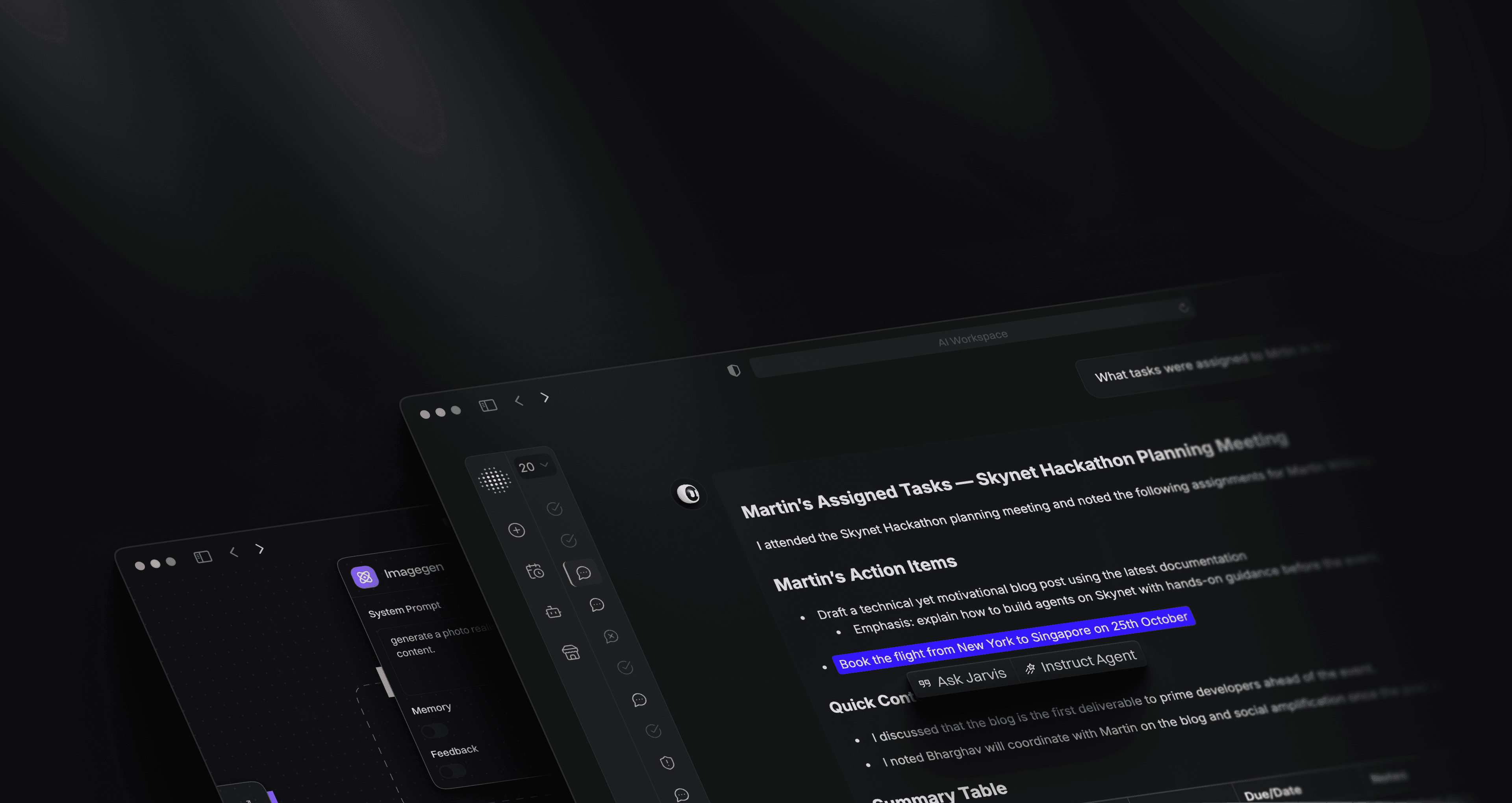
AI agents shine when they can sit across these channels, read the relevant data, and act in context. For example, a meeting bot that joins your calls, captures decisions, turns them into tasks, and pushes them into your project tool without anyone touching a keyboard. oai_citation:4‡Skynet
2. Manual follow up is the silent killer of productivity
Think about how much of a typical workday is actually chasing things:
Updating the CRM after a call
Writing routine follow up emails
Moving tickets to the correct status
Generating the same style of report each week
Humans are bad at these repetitive tasks. We forget, procrastinate or do them inconsistently. Agents are the opposite. They thrive on routine.
3. Enterprises need leverage, not more tools
Adding yet another AI subscription for each department quickly turns into chaos. Finance loses visibility, security teams worry about data sprawl, and employees suffer from tool fatigue.
One reason platforms like Skynet Workspace exist is exactly this: to provide one place where you can access language models, image generators, video tools and AI agents while sharing context and keeping data under control. oai_citation:5‡Skynet
Rather than adding tools, you add capabilities that plug into existing systems.
Where AI agents are already delivering value
Let us look at practical business scenarios where agents are already paying off.
1. Sales and customer success
Examples:
Auto generated call notes, pushed into the CRM with next steps
Follow up drafts tailored to the customer’s context
Lead enrichment: agents research a company, pull key signals and update records
With a workspace like Skynet, you can connect email, meetings and chats so that agents can synthesize conversations and prioritize follow ups for you. oai_citation:6‡Skynet
This does not replace your sales team. It removes the grunt work so they can actually sell.
2. Operations and internal support
Internal operations produce a lot of repetitive, rules based tasks that are perfect for agents:
Checking status across several systems and producing a daily summary
Watching for specific events (failed jobs, missed SLAs) and alerting the right person
Answering routine internal questions by reading documentation and policies
Agent platforms that support tool integrations, role based access control and granular budgets make this safer and more reliable for real businesses, not just demos. On Skynet, for example, agents operate within projects with controlled balances and explicit permissions to use specific tools. oai_citation:7‡Skynet Documentation
3. Knowledge management and documentation
Agents are particularly good at:
Turning messy transcripts and notes into structured docs
Keeping internal knowledge bases up to date
Surfacing the right snippet of information at the right time
When your AI workspace can connect to your docs, messages and meetings, those agents can finally see enough of your context to be useful instead of hallucinating. Skynet highlights this by letting you plug in your data sources so that agents can respond in a context aware way. oai_citation:8‡Skynet
Why a platform like Skynet.io matters in this shift
You could, in theory, assemble your own agent stack from scratch:
Choose several models
Build a custom orchestration layer
Wire up auth, billing, security and observability
Integrate your tools, APIs and data sources
Figure out how agents pay for external services
This is powerful, but it is also a long, expensive path. Many internal AI projects stall at this exact integration layer.
Skynet takes a different route.
From the public documentation and site, Skynet is focused on providing an all in one AI workspace and an underlying protocol where agents and humans share projects, connect tools, and handle payments safely. oai_citation:9‡Skynet
A few things stand out:
One subscription, many tools
Skynet lets you access multiple models and tools under one plan, rather than juggling many separate vendor accounts. oai_citation:10‡SkynetYour data as a first class citizen
The workspace is built to plug in your emails, chats, meetings and documents, so AI agents can work with real context instead of toy examples. oai_citation:11‡SkynetAgentic automation built in
You can highlight text, start agents directly from your workflows, and let them work across integrated tools rather than living in a single chat window. oai_citation:12‡SkynetPayment rails for agents
On the protocol side, Skynet gives agents a way to create projects, receive budgets in a stable unit, subscribe to tools, and pay based on actual usage. This means agents can autonomously consume external services without losing financial control. oai_citation:13‡Skynet Documentation
In other words, instead of asking every business to build its own mini "agent internet", Skynet tries to provide the plumbing.
How to adopt AI agents in a sane way
You do not need to transform your entire company overnight. A more realistic playbook looks like this.
Step 1: Pick one department and one painful workflow
Some good starting points:
Sales: post call follow up and CRM hygiene
Customer support: summarizing tickets and suggesting replies for agents to approve
Operations: daily or weekly status reports assembled from several tools
Define a simple goal like: "Reduce manual time spent on X by 30 percent while keeping or improving quality."
Step 2: Centralize access to AI and data
Before you build anything fancy, make sure:
Your team has one consistent workspace to access AI
The key data sources for that workflow are connected
For example, in Skynet you can bring models, messaging tools, and meeting data into one place so that both humans and agents see the same context. oai_citation:14‡Skynet
Step 3: Start with a human in the loop agent
Design an agent that assists rather than acts fully autonomously at first. For example:
It drafts emails, but a human hits send
It updates a suggested CRM record, but a human approves the changes
It prepares a report, but a manager reviews before sharing
Most modern agent platforms, including Skynet, support this pattern by returning results to the user and only executing actions that they authorize. oai_citation:15‡Skynet Documentation
Step 4: Measure, refine, then add more autonomy
Track simple metrics:
Time saved per week
Error rates or corrections needed
User satisfaction
As trust grows, you can grant the agent more permissions and budget inside a controlled project. With Skynet’s project based model and role based access control, you can increase autonomy in a safe way: the agent can only spend from its approved budget and only on approved tools. oai_citation:16‡Skynet Documentation
Step 5: Expand horizontally
Once you have one successful agent use case, you can:
Replicate the pattern in another department
Introduce specialized agents that collaborate
Standardize how your company builds and monitors agents
At this point, the question is no longer "Should we use AI agents?" but "Where else can we give agents boring work that humans should not be doing?"
Why "maybe later" is becoming a risky answer
In technology, there is a window where early adopters test the new thing and everyone else can wait. We are passing that window for AI agents.
Several signals point in the same direction:
Large enterprises are already running agent pilots across development, support, and operations. oai_citation:17‡Wikipedia
Agent focused infrastructure like Skynet’s protocol and workspace is maturing quickly. oai_citation:18‡Skynet
Tool vendors are exposing more of their products through APIs and AI friendly interfaces, making them easier for agents to consume. oai_citation:19‡Skynet Corp
If your competitors can handle more customers, ship faster, and operate leaner because agents are doing a chunk of the work, it is hard to justify staying fully manual.
Final thoughts
AI agents are not magic. They will not fix a broken product, a misaligned team, or a bad market. But they are rapidly becoming the default way high performing teams handle repetitive, multi step, and context heavy tasks.
For most businesses, the question is not "Should we use AI?" anymore, but:
How do we give AI agents enough context, tools and guardrails to work for us in a safe, measurable way?
This is where platforms like Skynet.io are worth a serious look. They give you a shared AI workspace, agentic automation, and the underlying payment and access rails that agents need to operate in the real world, so you can focus on designing good workflows rather than wiring infrastructure.
Start small. Choose one use case. Plug it into a capable agent platform. Measure the impact.
Once you see a well designed agent quietly closing loops in the background while your team focuses on higher value work, it becomes clear why using AI agents is not just a nice idea anymore.
It is a must.
Join the AI Revolution
Ready to start your AI journey with us?
© 2025 Copyright Skynet DeCloud Labs
Join the AI Revolution
Ready to start your AI journey with us?
© 2025 Copyright Skynet DeCloud Labs
Join the AI Revolution
Ready to start your AI journey with us?
© 2025 Copyright Skynet DeCloud Labs